Rosebud vs Mindsera: Which AI-Powered Journal Fits Your Self-Growth Journey in 2026?
Rosebud vs Mindsera: Compare AI journaling depth, frameworks, and privacy. See which platform goes deeper for emotional and cognitive self-reflection.
Last updated: May 2026
Quick verdict: Rosebud is the better lightweight choice for emotional support through conversational AI ($12.99/month). Mindsera goes a lot deeper across emotional, cognitive, and personality dimensions with a three-mode interface, 50+ mental model frameworks, and a proprietary emotion model ($14.99/month).
Choosing between Rosebud and Mindsera for your AI-powered journaling practice often comes down to these five questions:
- Do you prefer a primarily conversational journaling companion, or a layered reflection experience that combines focused writing, conversational AI, and multi-perspective feedback?
- Are you looking for guided wellness frameworks, or a broader library of mental models combined with deep emotional analysis?
- Is depth of insight important to you, understanding not just how you feel, but which specific thoughts trigger those feelings?
- Do you want AI that leads the conversation, or AI that reflects on your writing and offers multiple perspectives?
- Are you willing to invest more for a broader self-reflection toolkit, or do you prefer a lower price point focused on conversational emotional support?
In short, here’s what we recommend:
🥀 Rosebud is the conversational AI journaling companion built for emotional wellness and personal growth. With its interactive conversational modes, guided journals, and frameworks rooted in Cognitive Behavioral Therapy (CBT) and Acceptance and Commitment Therapy (ACT), it helps users process emotions, identify thought patterns, and build consistent journaling habits.
Backed by $6 million in seed funding from Bessemer Venture Partners and other investors, Rosebud is designed to feel like a supportive companion that guides you through a back-and-forth exchange. At $12.99/month or $107.99/year for the premium Bloom plan, it offers a polished conversational experience focused on emotional self-awareness.
🧠 Mindsera approaches journaling as a practice for deeper self-understanding, spanning both emotional insight and cognitive growth. With its three-mode interface (focused writing, conversational mode, and editor-based reflection with layered AI), a “Go Deeper” AI reflection feature with fully customizable tone and direction, AI personas called “Minds” that comment on your writing from multiple perspectives, wellness frameworks including CBT coaching, over 50 mental model frameworks, and a proprietary emotion tracking model that connects specific thoughts to specific feelings, Mindsera is built for anyone who wants their journaling to go deeper.
As an independent, non-VC-backed company, its incentives are aligned with user privacy rather than hyper-growth. At $14.99/month or $129/year for the Genius plan, Mindsera is the choice for those who see journaling as a tool for self-reflection, processing difficult emotions, sharpening thinking, and building self-awareness over time.
Both platforms offer AI-powered journaling with personalized insights, but they take different approaches to how deep that reflection goes and how AI participates in the process.
Table of contents:
- Rosebud vs Mindsera at a glance
- Two approaches to AI-powered self-reflection
- Rosebud excels at conversational emotional support
- Mindsera delivers depth in insight and structured thinking
- AI capabilities reveal different design priorities
- Insights and pattern recognition approaches
- Frameworks and guided experiences take different paths
- Pricing and value for different types of journalers
- Privacy and security considerations
- Rosebud vs Mindsera: Which should you choose?
- Frequently Asked Questions
Rosebud vs Mindsera at a glance
| Feature | Rosebud | Mindsera |
|---|---|---|
| Core Experience | ||
| Core Approach | Conversational emotional companion | Deep self-reflection & cognitive growth |
| Interface Style | Conversational with hybrid modes | Three-mode interfaceFocused writing, conversational mode & editor with layered AI |
| AI Interaction | ★★★★★Conversational dialogue | ★★★★★Go Deeper + “Minds” comments |
| Starting Price | $12.99/month$107.99/year | $14.99/month$129/year |
| Insights & Analysis | ||
| Emotional Analysis | ★★★Basic mood tagging | ★★★★★Proprietary modelPlutchik’s Wheel + thought-to-emotion mapping |
| Cognitive Tools | ★★★CBT/ACT frameworks | ★★★★★CBT coaching + 50+ mental models |
| Depth of Insights | ★★★★Emotional patterns over time | ★★★★★Emotions, cognition & personality |
| Personality Assessment | Not available | ★★★★★Big Five model analysis |
| Journaling Tools | ||
| Personalization | ★★★★★Long-term memory | ★★★★★Long-term memory + custom Go Deeper & Minds |
| Voice Journaling | ★★★★Premium feature | ★★★★Included in Genius |
| Goal / Habit Tracking | ★★★★AI-suggested goals | ★★★Habit tracker with streaks |
| AI-Generated Art | Not available | ★★★★Entry-inspired artwork with Mind Gallery |
| Journal Migration | Not available | Import from Rosebud, Stoic, Apple Journal |
| Summary | ||
| Best For | Conversational emotional processing | Deeper emotional insight + cognitive growth |
Two approaches to AI-powered self-reflection
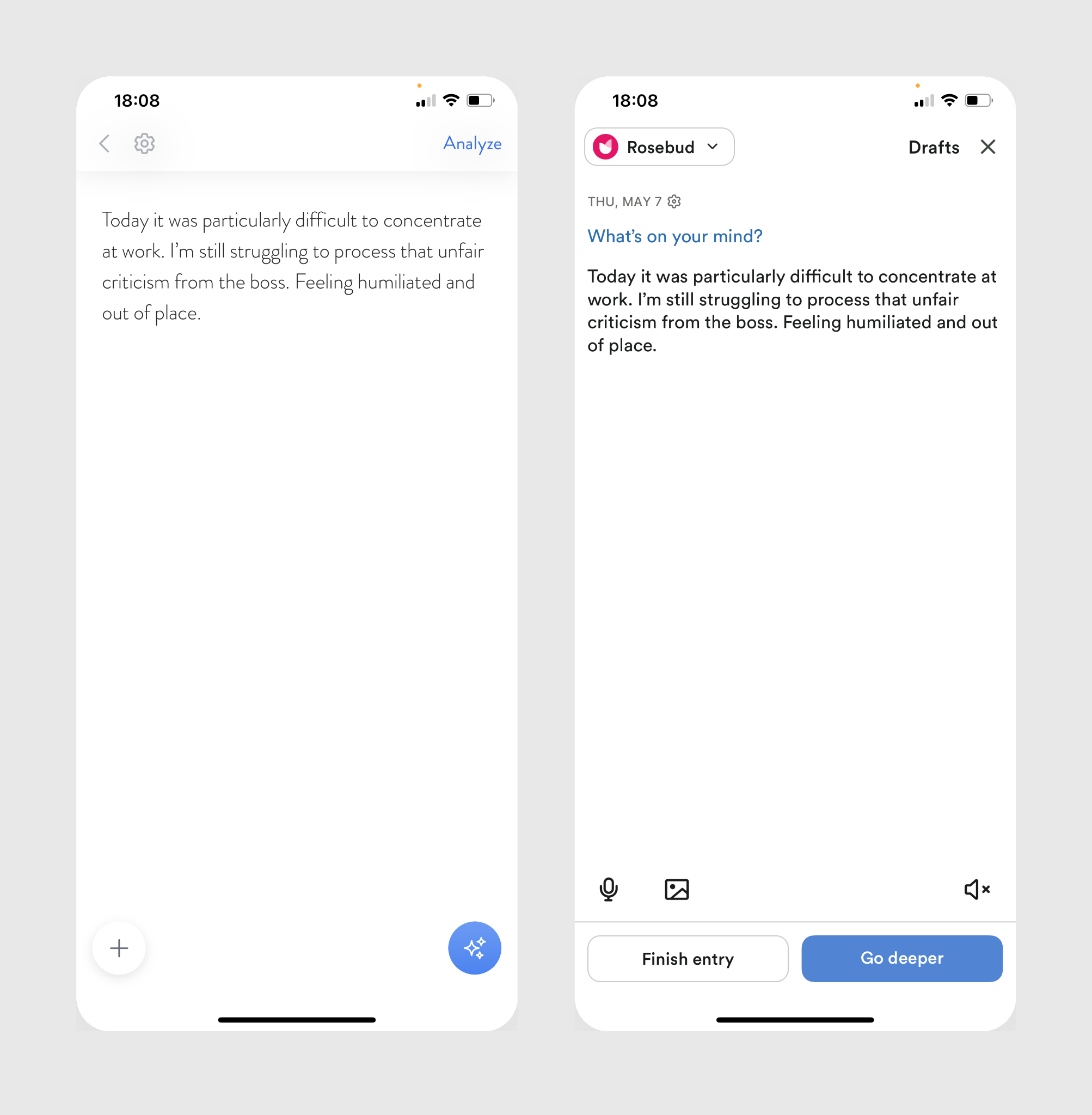
Rosebud was born from a personal need for better meaning in journaling.
Co-founded by Chrys Bader and Sean Dadashi, who met in a men’s group, the idea emerged when Dadashi, a long-time journaler, wanted to derive more insight from his entries using AI. When the technology caught up in 2023, they built Rosebud as a “mentor in your pocket”; a conversational AI companion designed to help users process emotions, build self-awareness, and navigate life’s challenges.
The platform is therapist-backed, incorporating evidence-based frameworks like CBT and ACT, and positions itself as a complement to professional therapy rather than a replacement.
Rosebud’s philosophy centers on increasing self-awareness through guided dialogue. The AI asks follow-up questions, validates feelings, and helps users connect the dots between their thoughts and experiences over time. It’s designed to feel like talking to a supportive, non-judgmental companion who remembers your history and helps you grow.
Mindsera emerged from a different vision.
Founded by Chris Reinberg; an entrepreneur fascinated by how the mind works and how “the software in your head runs your life”, Mindsera launched on March 16, 2023 as the first AI-powered journaling platform.
The founding belief is that in a world where AI automates more and more, the distinctly human element that remains is first-person experience. This can be a particular person, living a particular life, making meaning from it. Mindsera was built to be the place where users answer life’s everyday questions, day after day, year after year, which is the one thing AI can never do on someone’s behalf.
Where Rosebud positions itself as a complement to therapy, Mindsera positions itself as a tool for self-reflection, not therapy, not life coaching, but a practice of thinking on paper, enhanced by AI that helps you see what you might miss on your own.
The platform serves two distinct groups: people processing difficult emotions (anxiety, burnout, grief, major life transitions) who need a space to get their thoughts out and receive meaningful feedback, and people who use journaling as a tool for clarity, structuring decisions, examining patterns, and training cognitive skills.
Its integration of over 50 mental models, customizable AI personas called “Minds,” and a proprietary emotion analysis system reflects a belief that self-reflection should be advanced, multi-dimensional, and always evolving.
Mindsera is trusted by over 80,000 users across 168 countries, has been featured in The New Yorker and Forbes, was featured by Apple in 49 countries under “Apps We Love,” and has been mentioned in two Andreessen Horowitz (a16z) investment theses.
Clinical psychologists and psychiatrists have recommended the app to their clients for use between therapy sessions. As Dr. Amy Van Buren, a clinical psychologist, put it: “A lot of the feedback I receive from Mindsera is as good as, if not better than, what I could give my clients.”
Rosebud excels at conversational emotional support
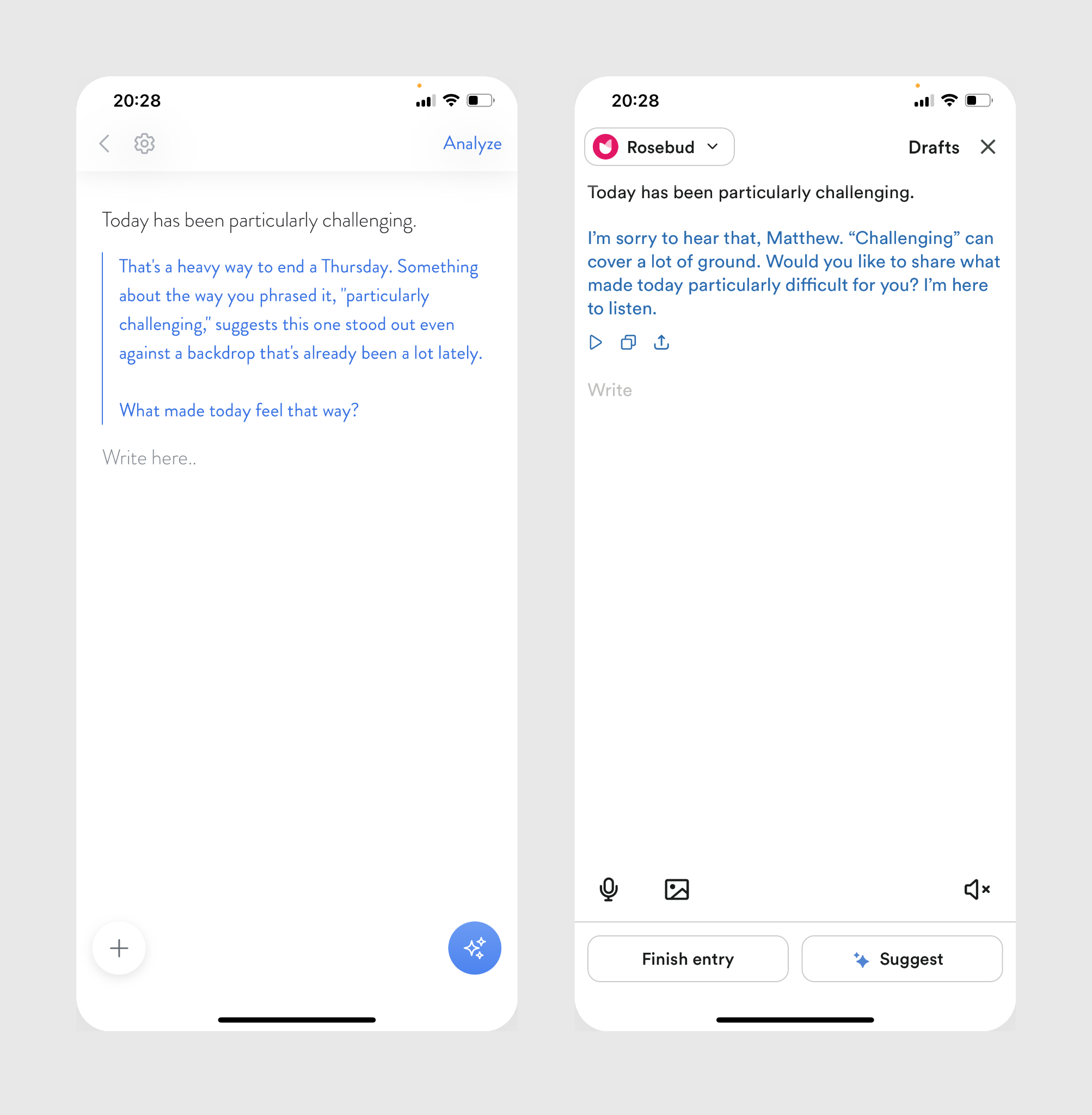
Rosebud’s strength lies in its conversational approach to journaling, creating an experience that feels more like a therapeutic dialogue than writing in a diary.
The conversational interface is central to this experience. Instead of leaving users with a blank page, Rosebud guides them through a back-and-forth exchange using its Interactive and Focused modes. The AI responds to entries with follow-up questions, validations, and insights, creating a dynamic flow that encourages progressively better reflection.
The platform also includes a traditional text editor, giving users the flexibility to choose their preferred journaling style. Testimonials describe the experience as feeling like talking to an insightful mentor who understands them.
The platform’s guided journals and workbooks are developed in partnership with mental health professionals and built on established therapeutic methodologies. Users can explore CBT-based journals that walk them through identifying and reframing negative thought patterns, ACT frameworks for processing challenging beliefs, and themed workbooks covering various wellness topics.
These are structured, objective-driven explorations informed by therapeutic best practices.
Rosebud’s long-term memory capability (available in the premium Bloom plan) is a core feature of its emotional support experience. Both Rosebud and Mindsera offer long-term memory as a foundational capability, connecting current reflections to earlier experiences and surfacing patterns that develop over weeks or months. In Rosebud’s case, this contextual awareness supports its conversational approach, allowing the AI to provide increasingly personalized and relevant guidance as it gets to know the user.
The Smart Mood Tracker goes beyond simple mood logging by helping users understand their emotional patterns and triggers. The AI automatically tags entries to track mood, relationships, and life themes over time. Weekly reports compile this data into actionable summaries of the user’s emotional landscape, key themes, and writing insights from the past week.
Where Rosebud shows limitations is in the depth of its analytical tools. While the therapeutic frameworks are effective for emotional processing, users looking for structured approaches to decision-making, multi-dimensional emotional analysis, or cognitive pattern detection will find fewer resources compared to what Mindsera offers.
Mindsera delivers depth in insight and structured thinking
Mindsera approaches journaling as a practice for building self-understanding; emotional, cognitive, and personal.
Its core philosophy can be summed up in one word: depth. Where many journaling tools stay at the surface, Mindsera is designed to help you go deeper into your thinking, deeper into your emotional patterns, and deeper into who you are over time.
The editor-based interface provides a distraction-free writing environment with a clean, minimalist design that supports both light and dark modes across seven color themes. The design is frequently cited by users as a reason they choose and stick with Mindsera.
As one user who actively uses both platforms put it: “This is exactly what I was looking for! Clean UI, personalized prompts, summaries & analyses of journaling, privacy prioritized.”
Physical journals are decorated with care; the cover, the texture, the vibe matters to journalers. Mindsera brings that same intentionality to the digital experience.
The three-step reflection flow
Mindsera’s core journaling experience follows a deliberate three-step process:
Step 1: Write. You start with a blank page designed for reflection where your thoughts are central, not a chat prompt. This is journaling as it’s meant to be: you, your thoughts, no interruptions.
Step 2: Go Deeper with AI. The “Go Deeper” feature is Mindsera’s core AI interaction, and it’s far more than a simple follow-up button. After writing, clicking Go Deeper generates a thoughtful AI reflection based on what you just wrote, designed to spark deeper thinking rather than provide answers or summaries.
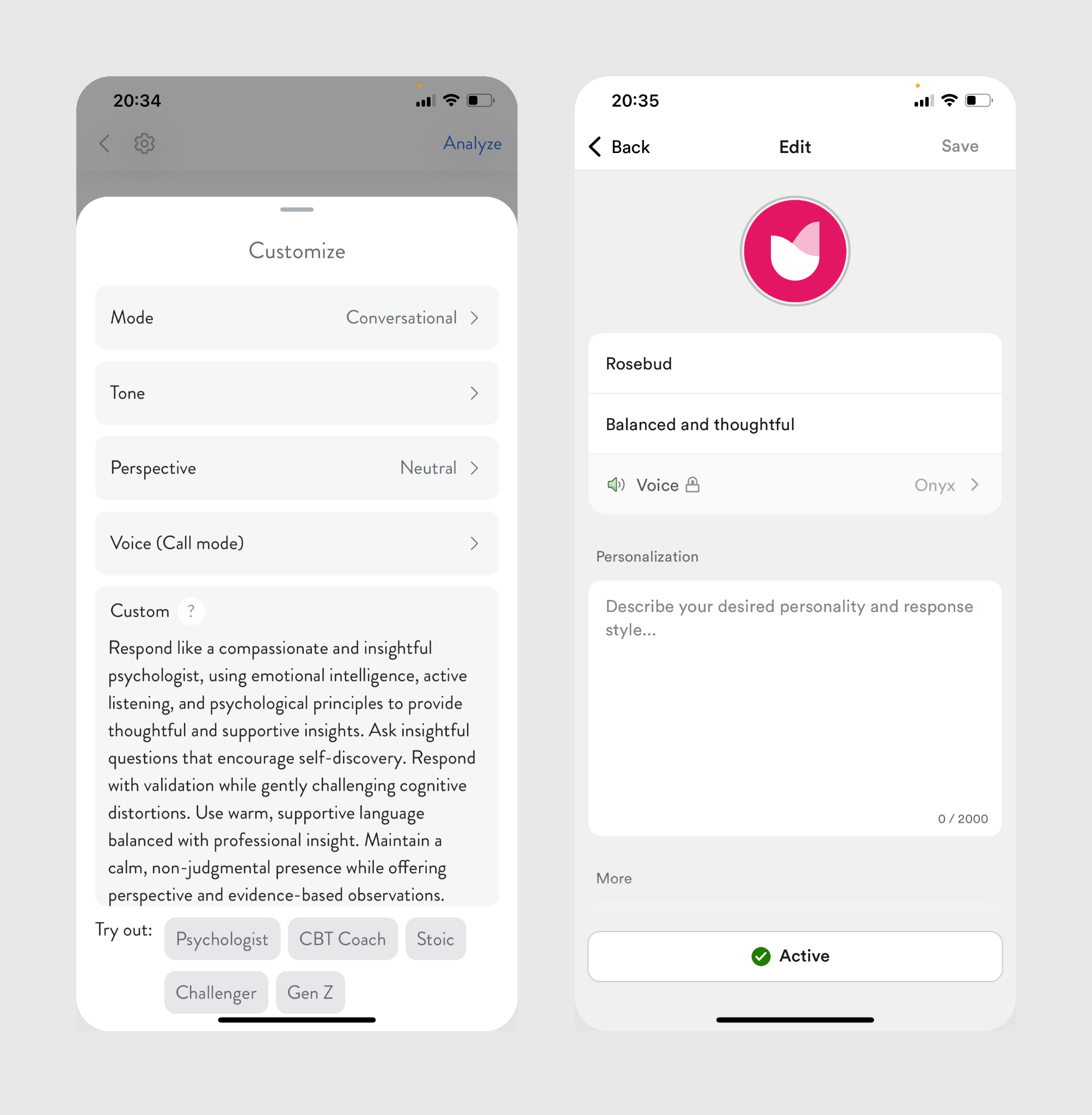
What makes it powerful is the customization: users can choose between conversational or question-only mode, adjust the tone (neutral, gentle, or direct), set a guiding perspective, pick from preset directions like “Psychologist,” “CBT Coach,” “Stoic,” or “Challenger,” and add custom instructions for unique response styles.
Users can also receive AI-generated prompts to start an entry, often drawn from recurring themes in past journals. The result is confusion turning into clarity; a personalized reflection experience that adapts to how each user wants to think.
Step 3: Invite the Minds. The “Minds” feature transforms solitary journaling into a multi-perspective experience. Different AI personas scan the entry, highlight specific parts of the text, and leave insightful comments directly in the margins similar to a collaborator reviewing a shared document, but with AI perspectives instead of real people.
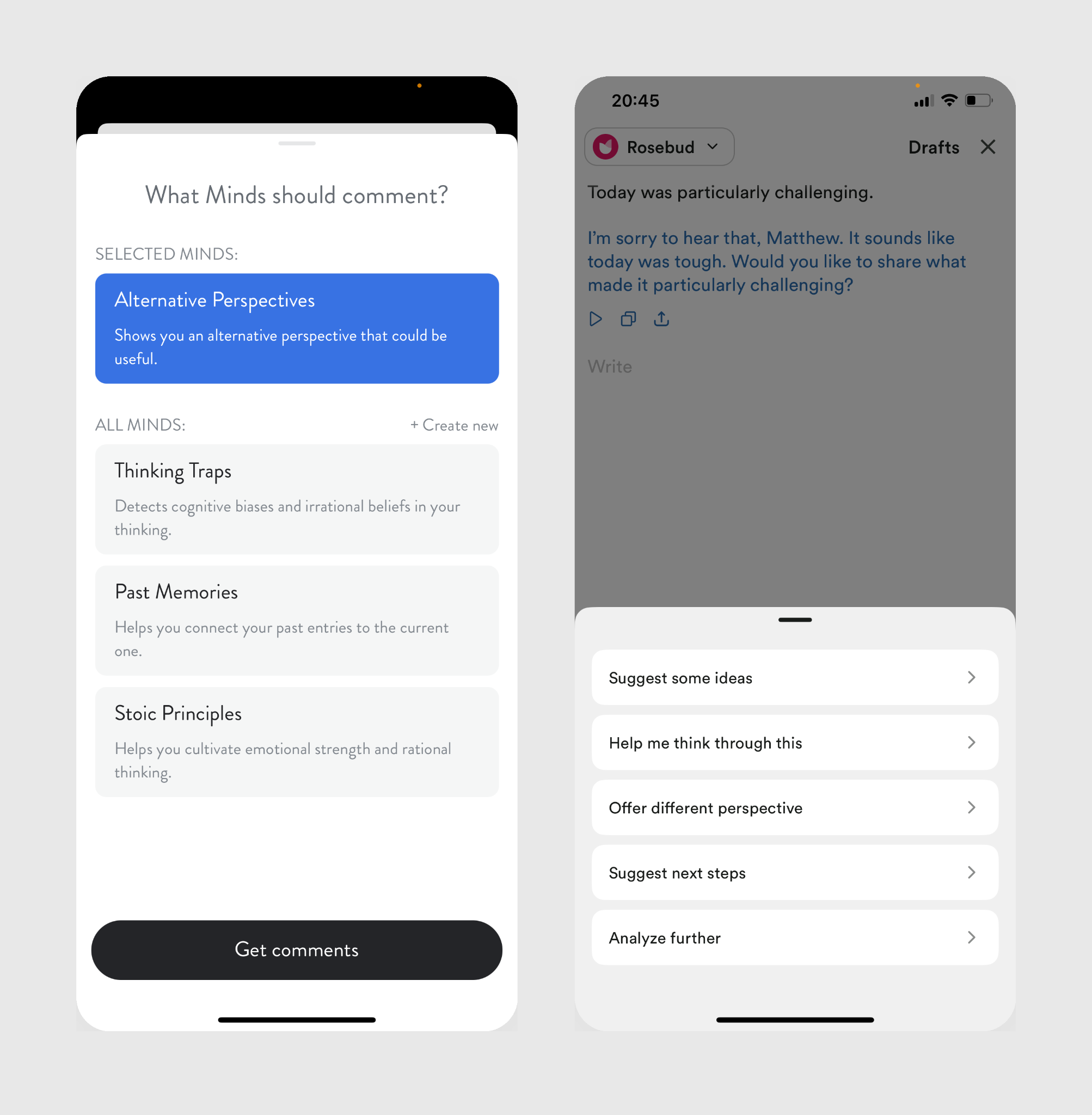
Pre-built Minds include Stoic Principles for rational thinking and resilience, Alternative Perspectives for challenging viewpoints, Thinking Traps for identifying cognitive biases, and Past Memories for connecting current entries to past reflections. Users can also create custom Minds tailored to specific frameworks, spiritual perspectives, or the thinking style of a particular individual.
Frameworks and cognitive tools
The library of over 50 frameworks built on established mental models is where Mindsera expands beyond emotional insight into structured thinking.
These frameworks span six categories; journaling, productivity, decision-making, problem-solving, wellness, and business, and include models like First Principles Thinking, The GROW Model for goal-setting, Inversion for tackling problems from the opposite direction, Ikigai for finding purpose, and Anti-Goals for gaining clarity on what to avoid.
Each framework guides users through a series of questions designed to approach challenges systematically, and the AI provides analysis and better follow-up through the Go Deeper feature.
The AI-generated artwork feature adds a creative dimension.
After completing an entry, Mindsera transforms the writing’s themes and emotions into a unique piece of art with multiple style options, creating a visual “Mind Gallery” that serves as an alternative way to review one’s emotional and intellectual journey over time.
Mindsera’s breadth of features does come with a learning curve for some users, though the platform addresses this with an interactive onboarding experience that walks new users through creating their first entry, making it easy to learn the key features by doing. The advanced AI features are also currently primarily available in English, though the platform already functions in multiple languages. Users report successfully journaling in German, Spanish, Dutch, Russian, and French, with official support for more languages planned.
AI capabilities reveal different design priorities
Rosebud’s AI is designed to feel like a warm, empathetic conversational partner.
The technology is built to ask the right follow-up questions at the right moments, creating an adaptive dialogue where each response builds on the last. User testimonials praise how natural the interactions feel compared to other AI apps. The AI’s strength is in its ability to validate emotions, provide gentle nudges toward better reflection, and create a sense of being heard.
Mindsera offers a similar conversational experience through its Go Deeper feature in conversational mode, but with a key difference: customizable tone and directness. Where some users find Rosebud’s approach consistently warm and validating, Mindsera lets users choose how their AI reflects back to them, from gentle and supportive to direct and no-nonsense. Users who have tried both platforms note this distinction; some prefer Rosebud’s consistently nurturing tone, while others want an AI that challenges them rather than always agreeing. As one user put it, Mindsera lets you decide the vibe of your reflection experience.
The conversational AI incorporates principles from CBT and other therapeutic modalities, meaning it can help users identify automatic negative thoughts, challenge cognitive distortions, and reframe unhelpful thinking patterns within the flow of natural conversation. The app processes entries to identify moods, topics, and relationships, then uses these elements to generate personalized prompts and feedback.
Rosebud’s AI also powers its goal and habit tracking capabilities. Based on journal entries, the AI proactively suggests relevant goals and habits through the “Happiness Recipe” feature. If a user frequently writes about stress, the AI might suggest a meditation habit.
These suggestions are derived directly from the user’s own reflections, making them more personally meaningful than generic recommendations.
Mindsera’s AI operates as both a reflection companion and an analytical thinking partner, functioning like an X-ray for your mind, revealing patterns, connections, and biases you might not see on your own.
The AI analyzes journal entries to detect emotional trends using a proprietary emotion tracking model integrated with Plutchik’s Wheel of Emotions, which goes well beyond basic sentiment analysis. This model connects specific thoughts to specific emotions, helping users understand not just what they feel but which thoughts trigger those feelings, building emotional intelligence over time.
A key distinction: Mindsera’s AI is designed to enhance the user’s thinking, not replace it.
The human-first approach means the AI offers alternative perspectives and surfaces cognitive biases, but the user’s thoughts remain central. Features like Thinking Traps detection and Alternative Perspectives actively prevent the echo chamber dynamic, where AI simply validates whatever the user says instead of offering better reflection.
Mindsera’s Cognitive Bias Detection serves both emotional and cognitive health.
Within the Cognitive Journaling framework, users can highlight text and ask the AI to scan for cognitive biases or irrational beliefs. The AI then provides an analysis of the user’s thinking patterns, helping them recognize and overcome flawed reasoning, whether that’s catastrophizing about a relationship or making business decisions based on sunk cost fallacy.
The “Ask Your Journal” feature allows users to engage with their entire journal history through thoughtful questions, asking things like “What were my biggest challenges last month?” or “What patterns show up when I write about work?” The AI synthesizes information from past entries to surface patterns, recurring themes, and evolving ideas, functioning as a thinking partner rather than a simple search.
Insights and pattern recognition approaches
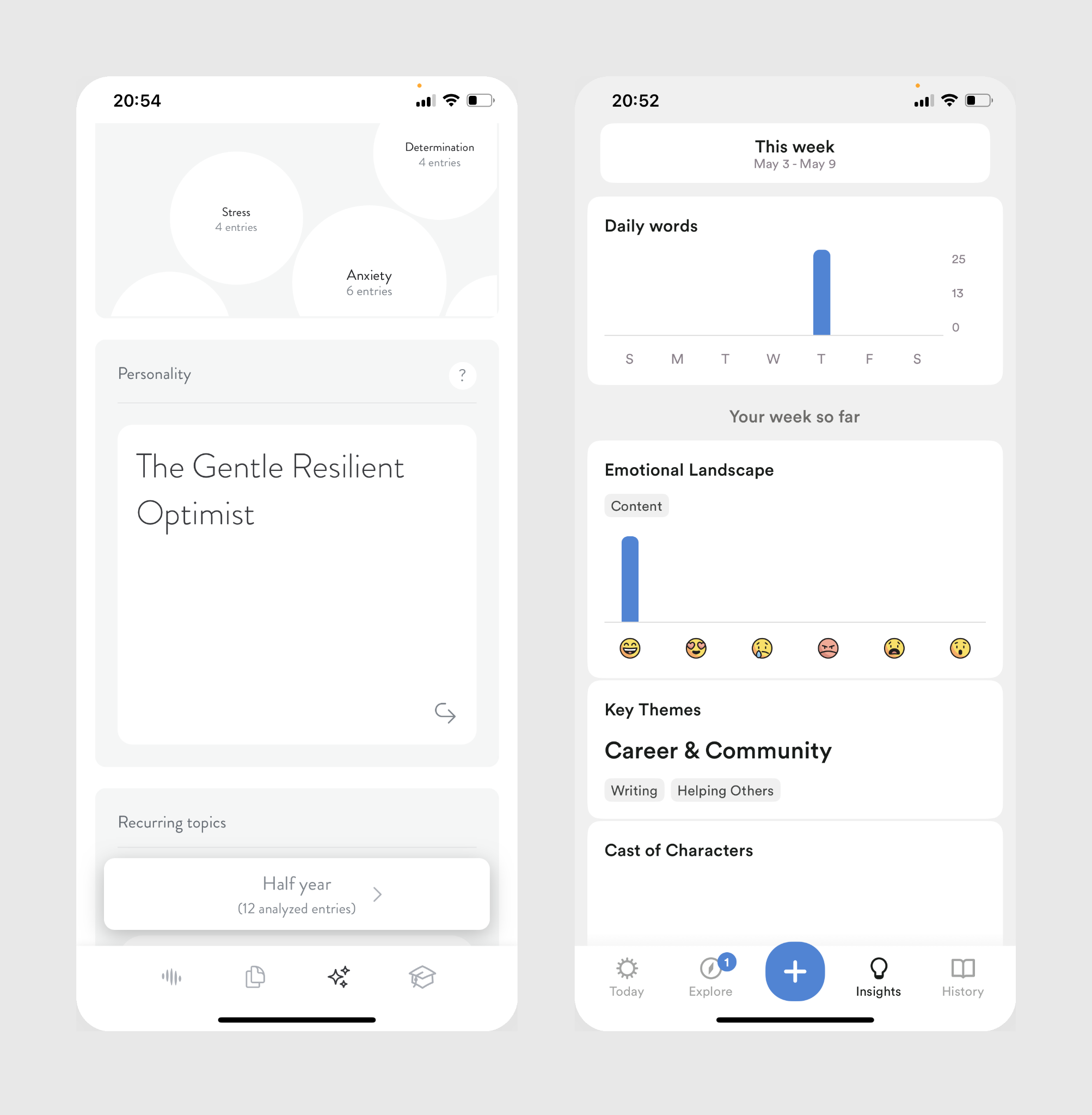
Rosebud primarily focuses its pattern recognition on emotional wellness.
The AI identifies recurring themes and emotional patterns across entries over time. The weekly reports compile these findings into summaries that highlight the user’s emotional landscape and key themes. The app’s analysis includes AI-assisted mood identification and contextual tracking that helps users understand what influences their emotional states.
The “Ask Rosebud” feature (available in the Bloom plan) allows users to ask the AI questions about themselves based on their journaling history, enabling self-discovery through direct inquiry. The auto-tagging system automatically categorizes entries, making it easier to trace patterns across different topics and time periods.
Mindsera takes a more multidimensional approach to insights.
The platform provides emotion and sentiment analysis using its proprietary emotion tracking model integrated with Plutchik’s Wheel of Emotions, detecting a richer spectrum of feelings such as anticipation, trust, and surprise.
What sets this apart is the specificity: users can view their emotional state over any timeframe in a visual bubble chart, with the ability to click on specific emotions to see which thoughts and entries triggered them.
This isn’t just tracking based on anxiety; it’s understanding what made you anxious, building the kind of emotional intelligence that comes from seeing the connection between your thoughts and your feelings.
Beyond emotional analysis, Mindsera provides automatic summaries, recurring topic analysis that identifies persistent thought patterns across entries, and the dynamic Big Five personality assessment that evolves based on journal content.
The insights page aggregates data across chosen timeframes, allowing users to track not just how they feel but how their personality traits and cognitive patterns shift over time.
As one long-time user described it: “Mindsera has become central to how I think. Not just record thoughts, but actually think, and revisit my thoughts. The actual value is context. It connects new reflections to previous ones, surfaces patterns I’ve missed, and helps me see how ideas evolve over time. It’s become my thinking partner, not just a record keeper.”
Mindsera also sends personalized weekly review emails described as “Spotify Wrapped, but for your mind, every week”, that summarize journaling stats and analyze mood and thought patterns from the previous week, supplementing the in-app insights with an external touchpoint that encourages continued engagement.
The difference in approach is clear: Rosebud’s insights are oriented toward emotional understanding and mental health support, while Mindsera’s insights span emotional awareness, cognitive patterns, personality traits, and thinking quality; a multi-dimensional view of who you are and how you’re evolving.
Frameworks and guided experiences take different paths
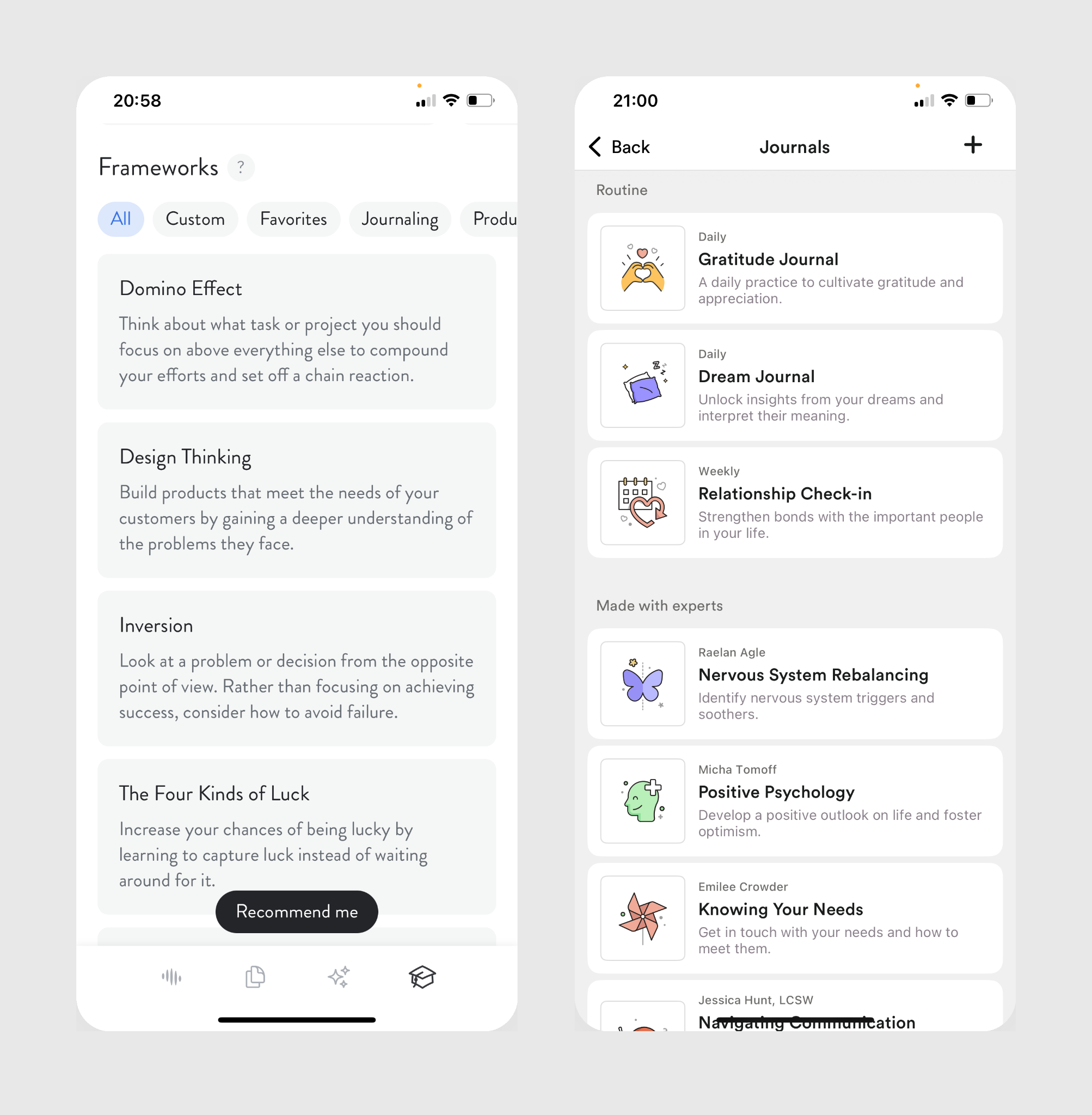
Rosebud offers guided journals and workbooks created in partnership with mental health professionals.
These are themed around wellness topics including gratitude and emotional reframing, among others. The frameworks are built on evidence-based therapeutic modalities including CBT, ACT, and Internal Family Systems (IFS).
What makes Rosebud’s guided experiences distinctive is how the AI interacts with them. Rather than presenting static prompts, the AI adapts its follow-up questions based on the user’s responses within the framework, creating a personalized exploration of each topic.
The “choose-your-own-adventure” element allows users to decide whether to go deeper, ask for a different perspective, or request help thinking through a specific issue after completing an entry.
Rosebud also offers morning intentions and evening reflections as daily rituals, along with dream interpretation journals. The emphasis is on making structured self-care accessible and engaging for people who might otherwise struggle to maintain a journaling practice.
Mindsera takes a broader approach with its framework library.
The 50+ frameworks span six categories; journaling, productivity, decision-making, problem-solving, wellness, and business, and are built on established mental models.
These include The GROW Model for coaching and goal-setting, First Principles Thinking for breaking down complex problems, Inversion for tackling challenges from the opposite direction, Anti-Goals for clarity through avoidance, and wellness frameworks for emotional processing and self-understanding.
The frameworks function like guided meditation for the mind, providing structured thinking exercises that train cognitive skills alongside emotional awareness. The deeper purpose is internalization: by repeatedly working through a thinking structure, users absorb it into their own mental toolkit, making these frameworks part of how they naturally approach problems, decisions, and self-reflection long after the journaling session ends.
Each framework presents a series of structured questions designed to guide the user through a specific thinking process. Users can view and answer one question at a time or have all questions displayed in the editor at once. They can also access additional context and examples for each question when they need guidance.
Mindsera adds flexibility through customizable frameworks. The “Set the day” and “End the day” frameworks, for example, help users bookend their days with intentional reflection, and can be personalized by editing existing questions, adding new ones, or removing unhelpful prompts. A “smart questions” feature allows users to set a topic, and the AI generates a new, unique question related to that theme each time the framework is used, keeping recurring routines fresh and engaging. Like Rosebud’s daily rituals, these features make structured self-reflection accessible even for people who struggle to maintain a journaling habit, while giving experienced journalers the depth to keep growing.
Users can also create their own frameworks from scratch, and Mindsera offers courses built around their frameworks, particularly around cognitive fitness topics like decision-making, critical thinking, and cognitive flexibility, further expanding the learning experience.
Pricing and value for different types of journalers
Rosebud operates on a freemium model with a permanent free tier and a premium “Bloom” subscription.
The free version includes core journaling with AI-powered features like Dig Deeper, entry reflection, auto-tagging, weekly reports, and unlimited entry history. However, it limits personalized prompts to 2 per day and excludes key premium features like long-term memory, custom journals, Ask Rosebud, call mode, voice journaling, and prompt bookmarking.
The Bloom subscription unlocks all features at $12.99/month or $107.99/year (equivalent to $8.99/month). Rosebud also offers a 40% discount for eligible students, senior citizens, individuals with disabilities, active military service members, and veterans (available for web subscriptions only).
Mindsera also follows a freemium model with a free “Curious” plan and a paid “Genius” plan.
The Curious plan includes a minimal journal, habit tracker, passcode, tags and highlights, and AI prompts.
The Genius plan at $14.99/month or $129/year unlocks the full feature set: voice journaling, physical journal scanning, conversational mode, emotional analysis, Ask Your Journal, recurring topics analysis, AI Minds comments, automatic summaries, personality assessment, artwork generation, personalized suggestions, weekly review email, 50+ writing frameworks, custom frameworks, and framework courses.
Mindsera also offers a 40% discount for students, seniors, and individuals with disabilities — matching Rosebud’s accessibility pricing, so both platforms are equally accessible for budget-conscious users.
At full annual pricing, Mindsera costs about $21 more per year than Rosebud ($129 vs $107.99).
The monthly pricing difference is $2 ($14.99 vs $12.99). Part of Mindsera’s pricing reflects its use of the most advanced AI models available, including reasoning models, which deliver more intelligent and nuanced reflections. For this premium, Mindsera users also get access to the Go Deeper customization, Minds feature, 50+ mental model frameworks, proprietary emotion analysis, personality assessments, AI-generated artwork with the Mind Gallery, and the broader self-reflection toolkit.
Both platforms offer free trials for their premium tiers, allowing users to test the full experience before committing.
The value calculation depends on what you need. If your primary goal is emotional support through a conversational AI, Rosebud’s lower price point delivers strong value for that experience.
If you want the best possible insights from your journaling spanning emotional analysis, cognitive patterns, personality traits, and structured thinking frameworks, Mindsera’s slightly higher price reflects a broader and deeper feature set. Both platforms are recommended by therapists for use alongside professional support. Mindsera also supports easy migration of journal entries from Rosebud, making it straightforward to switch if you want to try the difference.
Privacy and security considerations
Rosebud encrypts all data both in transit (using SSL) and at rest (using Google Cloud Platform encryption).
The company does not sell user data to third parties and does not share journal entries. For AI processing, Rosebud uses services from OpenAI, Anthropic, and Groq, with all data anonymized before processing.
Rosebud’s mobile apps support biometric authentication (Touch ID, Face ID, fingerprint, iris scanning) for additional security.
Users can export their data and request account deletion at any time, with the company committing to erase information within 30 days. Rosebud is VC-backed, having raised $6 million in seed funding led by Bessemer Venture Partners.
Mindsera encrypts user writing at rest using AES-256 encryption and uses TLS 1.2 or greater for data in transit.
The company explicitly states that it does not sell user data and that user data is not used to train AI models. Mindsera is hosted on Fly.io servers in both the US and EU (depending on user location), and as an EU-based company, it benefits from the hosting provider’s compliance with GDPR, EU-U.S. Data Privacy Framework, ISO 27001, and SOC 2 standards.
Users can add a passcode for additional account security (and biometric authentication can be enabled at the device level for any app), export their data in Markdown format at any time, and delete their accounts (which permanently removes all data). For AI features, Mindsera uses Anthropic, OpenAI, and Google.
A structural difference worth noting: Mindsera is an independent, non-VC-backed company, which means its growth incentives are aligned with user privacy rather than the hyper-growth pressures that come with venture capital funding.
Rosebud, backed by investors including Bessemer Venture Partners, 776, and Initialized Capital, operates within a different incentive structure. Both platforms prioritize user ownership of data and provide export capabilities.
Mindsera’s EU-based infrastructure and hosting provider certifications (ISO 27001, SOC 2) provide good data governance foundations. Both platforms have acknowledged that end-to-end encryption is not currently possible with AI-powered features that require server-side data access.
Rosebud vs Mindsera: Which should you choose?
The choice between Rosebud and Mindsera depends on what you want your journaling practice to accomplish, how deep you want your insights to go, and how you prefer to interact with AI.
Choose Rosebud if:
- Your primary goal is emotional wellness and mental health support through a conversational AI
- You prefer a chat-first journaling experience that feels like talking to a supportive, consistently nurturing companion
- You want guided journals based on CBT, ACT, and other evidence-based therapeutic frameworks
- You want AI-powered goal and habit suggestions derived from your own journal entries
- A lower price point matters ($107.99/year vs $129/year)
- You’re looking for an accessible complement to therapy or professional mental health support
Choose Mindsera if:
- You want the best possible insights from your journaling, like emotional, cognitive, and personal
- You’re processing difficult emotions (anxiety, burnout, grief, life transitions) and want more than surface-level feedback
- You want a flexible interface that supports focused writing, conversational AI, and editor-based reflection with layered AI
- A customizable AI reflection experience matters, choosing the tone, mode, perspective, and direction of your AI interactions
- You want access to 50+ mental model frameworks spanning wellness, CBT coaching, decision-making, productivity, and more
- Getting feedback from multiple AI perspectives (“Minds”) that challenge your thinking appeals to you
- You value an independent, non-VC-backed company whose incentives are aligned with your privacy
- You want to understand not just how you feel but which specific thoughts trigger those feelings
- A dynamic personality assessment based on the Big Five model is valuable to your self-understanding
- You see journaling as a daily practice for self-reflection, getting emotions out to bring calm in, turning confusion into clarity
The AI-powered journaling space has room for both approaches because they serve different needs. Rosebud has built a conversational emotional companion that helps users process feelings, build self-awareness, and maintain mental wellness through guided conversation.
Its frameworks and long-term memory make it effective for individuals seeking accessible emotional support through dialogue.
Mindsera has carved out a distinct position as the deeper self-reflection tool, one that takes journaling seriously as a practice for understanding yourself. Its proprietary emotion analysis, customizable Go Deeper feature, multi-perspective Minds, and structured thinking frameworks create a comprehensive environment for anyone who wants their journaling practice to be more than surface-level.
Users who have tried both platforms consistently cite Mindsera’s depth and design as the reasons they switched. Its growing base of 80,000+ users across 168 countries, clinical psychologist endorsements, and recognition from The New Yorker, Forbes, and Apple suggest that depth resonates.
The question isn’t which platform is better overall. It’s whether you want a conversational companion that supports emotional growth, or a multi-dimensional self-reflection tool that goes deeper into who you are and how you think. Both deliver meaningful value, and your choice should align with the kind of depth you’re looking for.
Also weighing a general-purpose AI? See our ChatGPT vs Mindsera comparison for how a dedicated journaling tool stacks up against a general LLM.
Frequently Asked Questions
What is the main difference between Rosebud and Mindsera?
Rosebud is a conversational AI journaling companion focused on emotional wellness through warm, guided dialogue using CBT and ACT frameworks. Mindsera is a deeper self-reflection platform that spans emotional, cognitive, and personality dimensions with 50+ mental model frameworks, customizable AI personas (Minds), Big Five personality assessments, and Plutchik-based emotional analysis. Rosebud uses a chat-based interface; Mindsera offers a three-mode interface combining focused writing, conversational mode, and an editor with in-line AI feedback.
How much do Rosebud and Mindsera cost?
Both platforms offer free tiers. Rosebud’s premium Bloom plan costs $12.99/month or $107.99/year. Mindsera’s Genius plan costs $14.99/month or $129/year. Both offer free trials for their premium tiers. Rosebud also offers a 40% discount for students, senior citizens, individuals with disabilities, and military members.
When should I choose Rosebud over Mindsera?
Choose Rosebud if your primary goal is guided emotional processing through warm, conversational AI dialogue. It’s ideal if you prefer a chat-based journaling experience, want guided journals based on CBT and ACT, value long-term AI memory that connects current reflections to past entries, want AI-powered goal and habit suggestions, prefer a lower price point, and value biometric app security on mobile.
When should I choose Mindsera over Rosebud?
Choose Mindsera if you want deeper insights across emotional, cognitive, and personality dimensions. It’s the better choice if you’re processing stress, anxiety, or difficult life transitions and want more analytical depth, prefer a flexible interface combining focused writing and editor-based reflection, want 50+ mental model frameworks spanning wellness to business, value feedback from multiple customizable AI personas (Minds), want dynamic Big Five personality assessments, and prefer a platform backed by an independent, non-VC-backed company with aligned privacy incentives.
Are Rosebud and Mindsera safe for storing personal journal entries?
Both platforms prioritize privacy and security. Rosebud encrypts data in transit (SSL) and at rest (Google Cloud Platform), does not sell user data, and anonymizes data sent to AI providers. Mindsera uses AES-256 encryption at rest and TLS 1.2+ in transit, is hosted on servers compliant with GDPR, ISO 27001, and SOC 2 standards, and explicitly states user data is not used to train AI models. A key structural difference: Mindsera is an independent, non-VC-backed company, while Rosebud is VC-backed, which creates different long-term incentives around data handling.
Can I switch from Rosebud to Mindsera?
Yes. Mindsera supports easy journal migration that lets you import entries from Rosebud, Stoic, Apple Journal, and other journaling platforms, so you can bring your existing journal entries with you when switching.