The 7 best AI journaling apps in 2026, tested
We tested the 7 best AI journaling apps of 2026: Mindsera, Rosebud, Reflection and more. Honest pros, cons, pricing, and free plans, compared side by side.

The 7 best AI journaling apps in 2026, tested
You’ve probably tried a notes app or a paper journal, heard that AI journaling gives you feedback instead of silence, and now you’re staring at a dozen near-identical “AI journal” apps wondering which one is worth your time.
Here’s the short answer: the category splits into two camps. Chatbots you talk at (Rosebud) and journals that analyze what you wrote. Mindsera now spans both: you can have a live voice conversation with your journal and still get the deep analysis a chat transcript never gives you. We use these apps daily, and this guide covers what each one actually does, what the free plans include, and where the paywalls start.
Key takeaway: The best AI journaling app in 2026 is Mindsera: you can type, speak, or call your journal for a back-and-forth conversation, and it reflects back with entry analysis, emotion detection, and long-term patterns. Rosebud is a decent chat-first alternative if all you want is the conversation, and Reflection is a solid free start. For a detailed head-to-head, see our Rosebud vs Mindsera comparison.
Quick list
- Mindsera: Best overall: conversational journaling with deep analysis
- Rosebud: Best for guided CBT-style chats
- Reflection: Best free start
- Reflectly: Best for mood-first simplicity
- Stoic: Best for structured daily routines
- Day One: Best for traditional journaling with light AI
- ChatGPT: The DIY option, with real limitations
How we chose
Every AI journaling app on this list went through the same questions:
- Does the AI reflect back, or just store? A journal that only saves your words is a diary with a login screen. The point of AI journaling is getting something back that you didn’t already know.
- Does it find patterns across entries over time? One clever reply is easy. Connecting this week’s entry to something you wrote in March is what makes the practice even more beneficial.
- What does the free plan actually include? Most “free” AI journals gate the AI itself. We checked where each paywall really starts.
- Is your data encrypted and excluded from model training? You’re writing down your most private thoughts. Encryption at rest and a clear no-training policy are minimum requirements.
- Does it work on iOS, Android, and web? A journal you can’t open on the device in front of you is a journal you’ll stop using.
One honest disclosure before the list: we build Mindsera, so we know it better than anything else here. That cuts both ways. We’re biased toward it, and we also know its weaknesses better than any outside reviewer, and we list them. For every other app, we journaled in it, tested the free tier and the paid features, and verified every price and feature claim against the vendor’s own site or app store listing. All prices below were checked in July 2026.
1. Mindsera: best overall, conversational journaling with depth
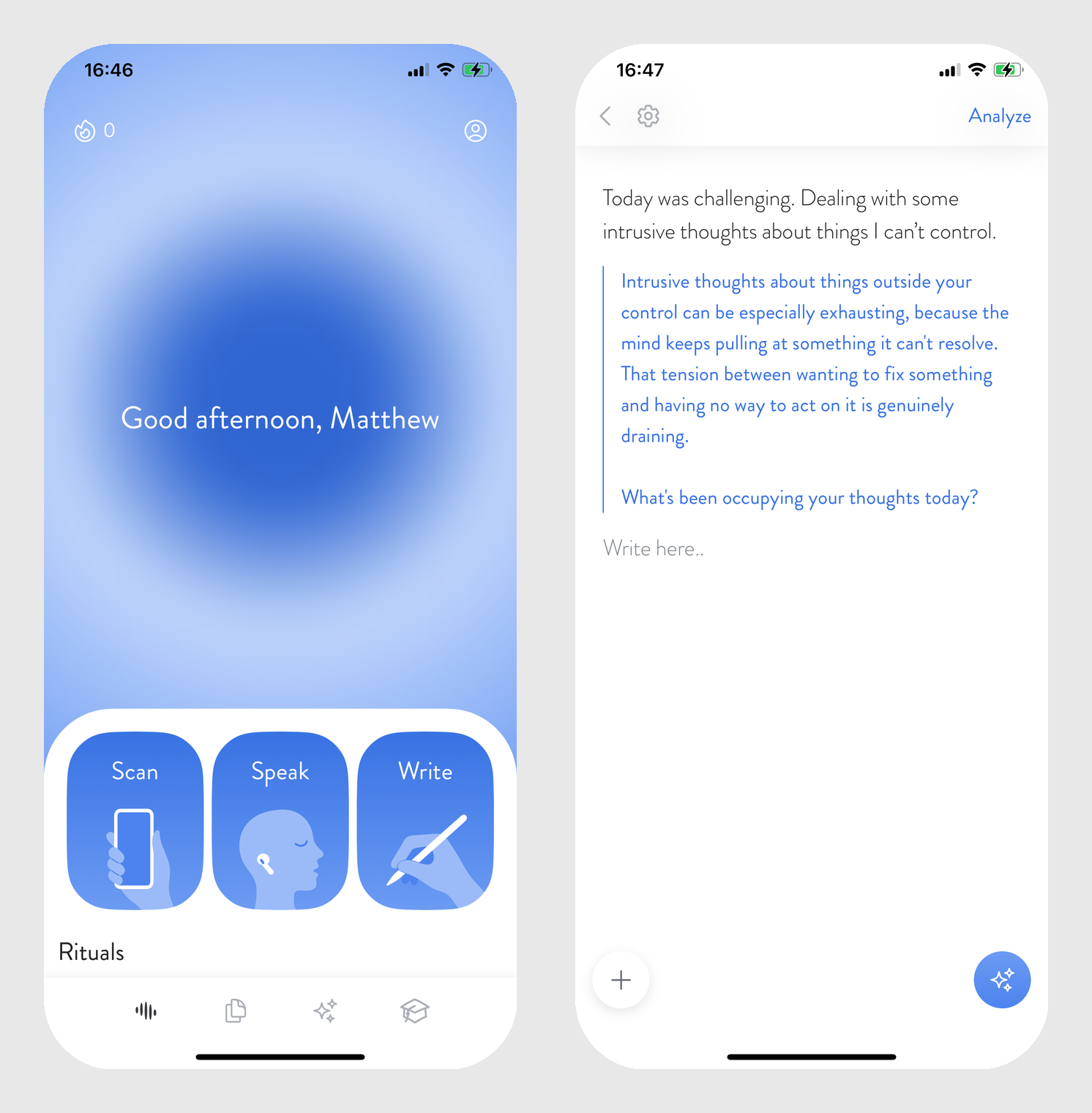
Snapshot: Mindsera treats journaling as a thinking practice, not a mood log. You reflect in whatever form your thoughts arrive, typed, spoken, or handwritten, and the AI reflects back: analyzing every entry, detecting emotions, and rolling them up into long-term patterns. Free Curious plan available; the Genius plan is $14.99/month, or $10.75/month billed annually ($129/year).
Why it works well. Most journaling apps stop at storage or a cheerful reply. Mindsera starts where your thoughts are: type on a blank page, speak with Voice Mode (supports Apple and Android recording on the go), have a back-and-forth voice conversation with Call Mode, like a coaching session with your own journal, or scan your handwritten pages into digital text. Conversational prompts know your past entries and ask the right next question, and morning and evening rituals give the habit a daily shape. Then the entry analysis takes over: every entry gets a private AI breakdown of themes, emotions, and key takeaways, plus a unique generated artwork that captures its mood.
Standout features.
Reflection: Voice Mode, Call Mode for interactive conversations, personal prompts that know your history, handwritten page scanning, morning and evening rituals, and Apple Health and Android Health app integrations for journaling on the go.
Analyze: Minds leave margin comments on your writing like a collaborator, every entry gets an AI breakdown with generated artwork capturing its mood, and Ask Your Journal lets you search your entire history for patterns.
Insights: Emotion detection rolls into long-term analysis showing how your mood shifts across weeks, months, and seasons, which thoughts drive those shifts, recurring topics detection, a living Big Five personality assessment, and personalized suggestions based on your patterns.
Review: Story View turns your journal into a scrollable narrative with daily, weekly, monthly, and yearly summaries, and a weekly Monday email with last week’s themes and wins.
Other strengths: the free Curious plan includes 52+ framework templates based on history’s best thinkers and smart highlights. Your writing is protected with AES-256 encryption and never used to train models. The iOS app holds a 4.9-star rating and Apple has featured it in 49 countries. You can import entries from Rosebud, Stoic, and Apple Journal if you’re switching.
Best for: People who want a journal they can talk to that also changes how they think. Call Mode and conversational prompts cover the back-and-forth that made chat-first apps popular, and the analysis underneath goes further than any of them. If you’re processing something difficult or making a hard decision, this is the deepest tool in the category.
Potential drawbacks: The depth can overwhelm you if all you want is a 30-second mood log. There’s a learning curve to the frameworks and Minds, even with the guided onboarding. And while the free Curious plan covers journaling basics, framework templates, and habit tracking, the AI analysis sits in Genius, so you need the trial or the paid plan to see where the app especially excels.
2. Rosebud: best for guided CBT-style chats
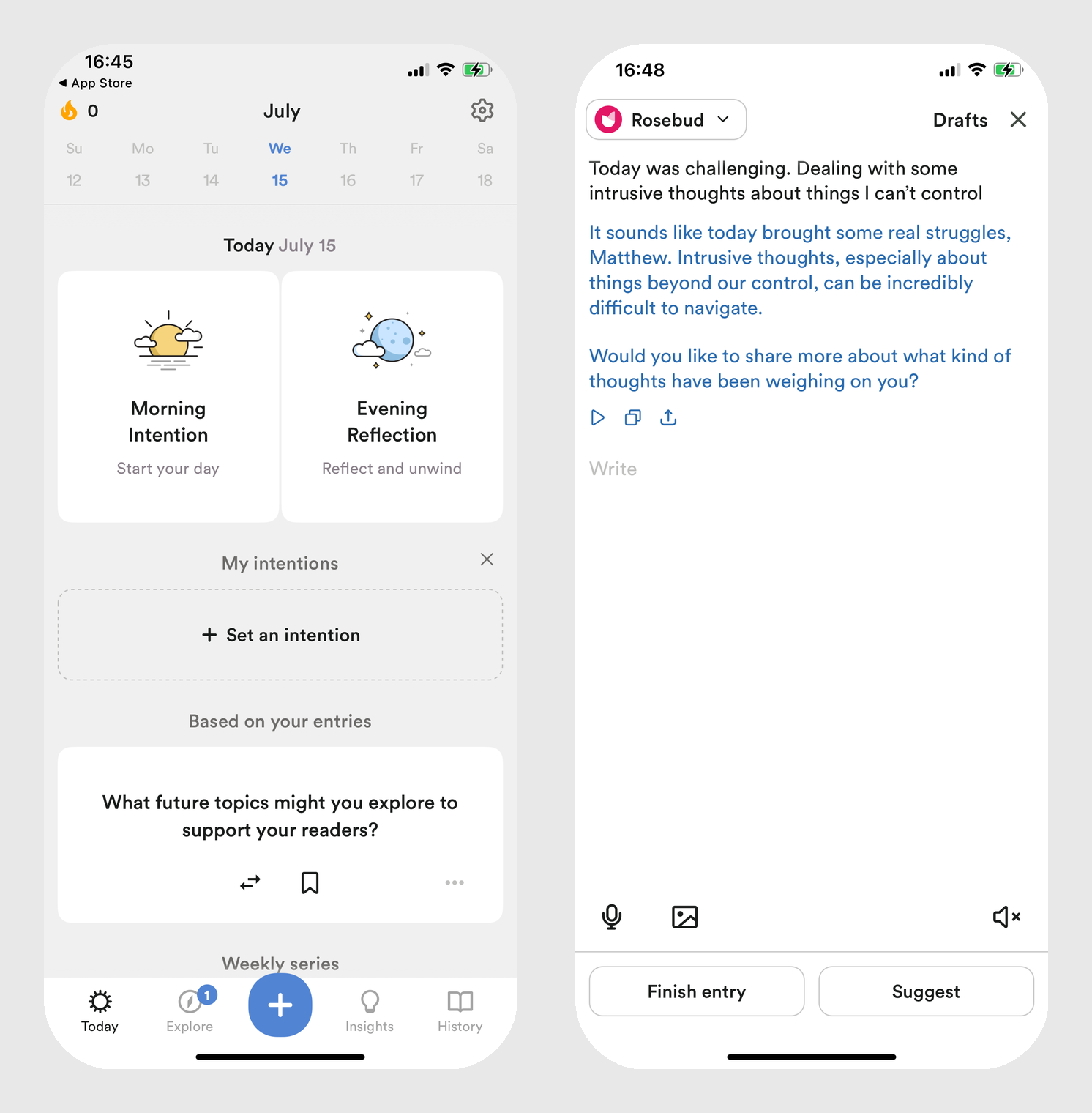
Snapshot: Rosebud is a chat-only AI journal that feels like texting a supportive mentor. It asks follow-up questions, validates feelings, and remembers your history. Free plan available; the Bloom plan is $12.99/month or $107.99/year.
Why it works well. If a blank page intimidates you, Rosebud removes it. The AI guides you through a back-and-forth exchange, and its guided journals are built with mental health professionals on CBT and ACT foundations. Long-term memory (a Bloom feature) lets the AI connect today’s entry to earlier ones, and weekly reports summarize your emotional patterns. It’s a polished, warm experience.
Standout features. Interactive and focused conversation modes, auto-tagging of moods and topics, AI-suggested goals and habits through its Happiness Recipe feature, dream interpretation journals, and morning and evening rituals.
Best for: People who specifically want structured, therapy-flavored chat sessions built on CBT and ACT workbooks. That guided format is Rosebud’s real specialty.
Potential drawbacks: The conversation is the whole product, and it leads: your entries end up as transcripts of the AI’s questions rather than your own thinking. The AI prioritizes validation over directness; a design choice that suits some people but may feel less challenging to others. Analysis stays at the surface: mood tagging and weekly themes, but no personality assessment, no long-term thought-to-emotion mapping, and no thinking frameworks. The free plan caps personalized prompts at 2 per day and holds back long-term memory, Rosebud’s most important feature. If you want both structured conversation and deep analysis, Mindsera covers both. Rosebud is the choice to go with if you prefer CBT-guided chats without the analytical layer. For a feature-by-feature breakdown, read the full comparison.
3. Reflection: best free start
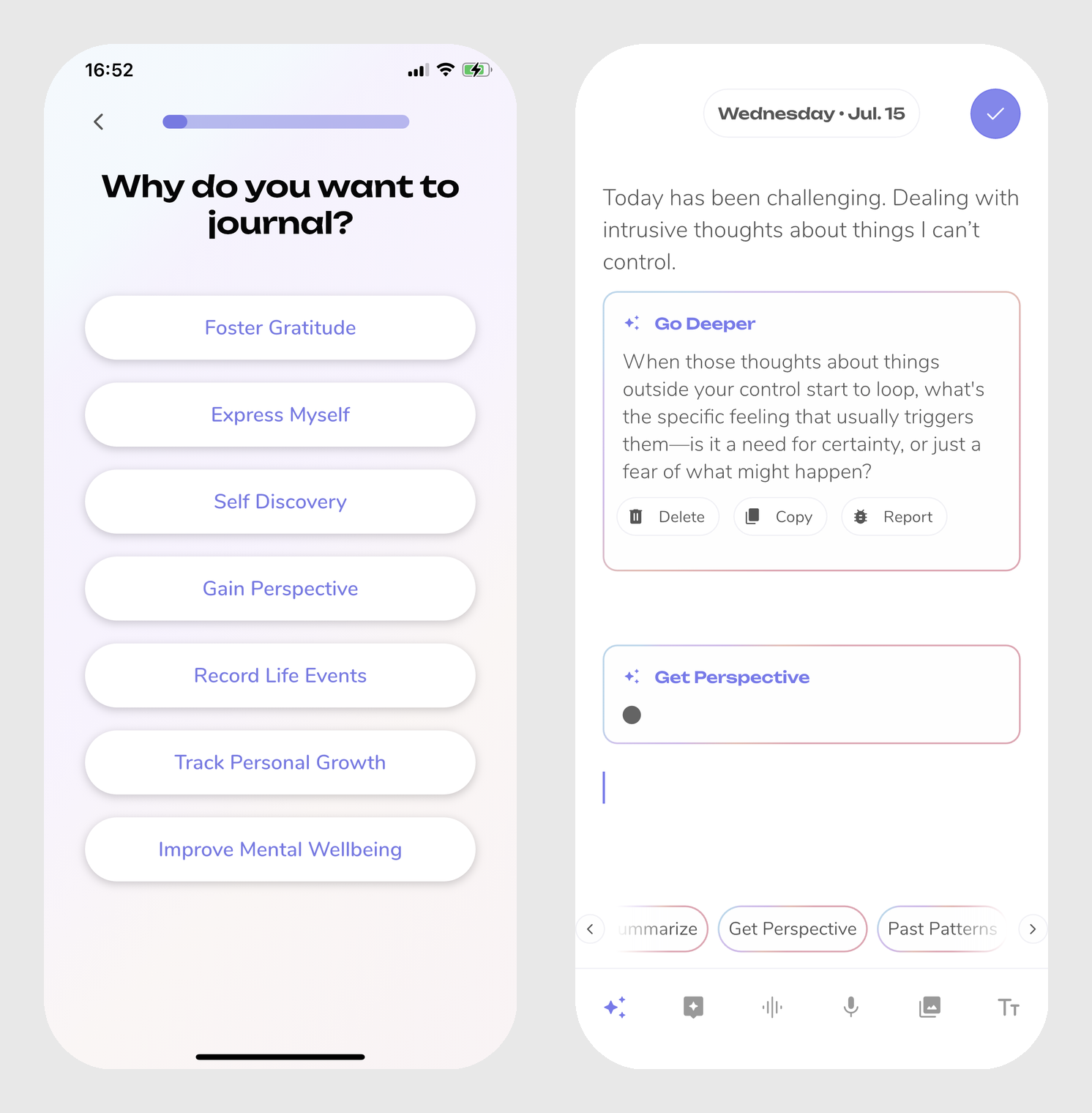
Snapshot: Reflection.app pairs classic guided journaling with an AI coach, and its free plan is the most generous in the category. Premium is $8/month, or $5.75/month billed annually, with a 7-day trial.
Why it works well. The free plan includes core journaling, daily prompts, guided monthly and annual reviews, and limited access to the AI coach, which is enough to build a real habit before paying anything. The AI coach asks personalized follow-up questions based on your entries and can summarize or find patterns across them on the paid plan.
Standout features. 100+ guided programs on Premium, voice transcription, a clean distraction-free editor, and apps for iOS, Android, macOS, and web.
Best for: Anyone who wants to try AI journaling without paying first. It’s also a good fit if you like structured check-ins like weekly and annual reviews.
Potential drawbacks: The AI layer is a coach bolted onto a traditional journal rather than the core of the product. Pattern detection and emotional analysis are lighter than Mindsera’s or Rosebud’s, and there are no personality insights or thinking frameworks.
4. Reflectly: best for mood-first simplicity
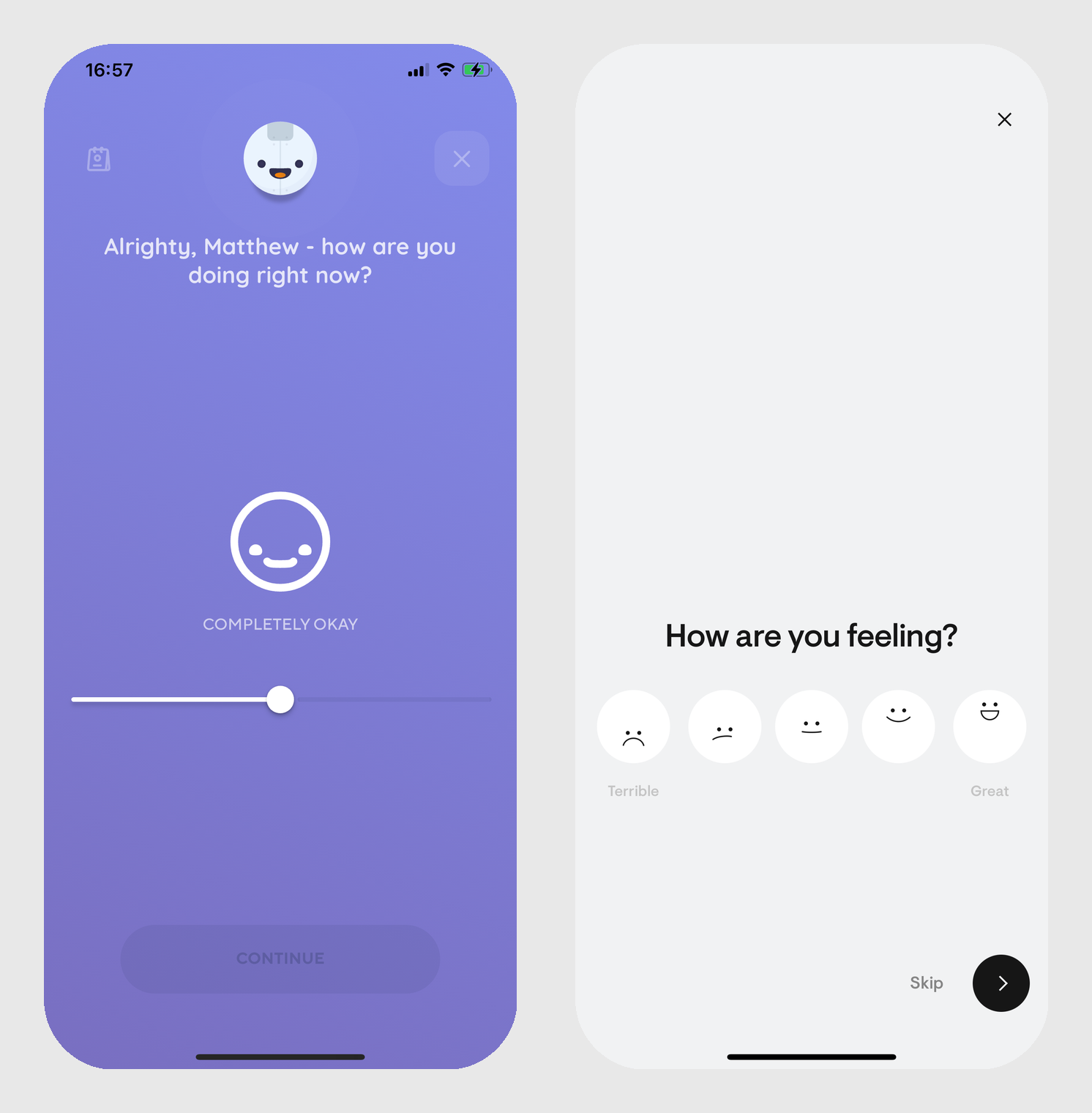
Snapshot: Reflectly bills itself as a journal and AI diary, but in practice it’s a mood tracker with journaling attached. You log how you feel, answer a short prompt, and get charts of your mood over time. Premium is $9.99/month or $59.99/year.
Why it works well. The check-in takes under a minute. Bright design, streaks, and mood statistics make it one of the easiest journaling habits to start, and for some people the low barrier is exactly what keeps them going.
Standout features. Daily mood logging with visual statistics, motivational prompts and affirmations, and a playful interface.
Best for: People who want a fast daily check-in and a picture of their mood over weeks and months, not deep written reflection.
Potential drawbacks: The “AI” is mostly scripted prompts rather than analysis of what you wrote. Entries are short by design, so there’s little for any AI to reflect on. If your goal is understanding why you feel what you feel, you’ll outgrow it quickly.
5. Stoic: best for structured daily routines
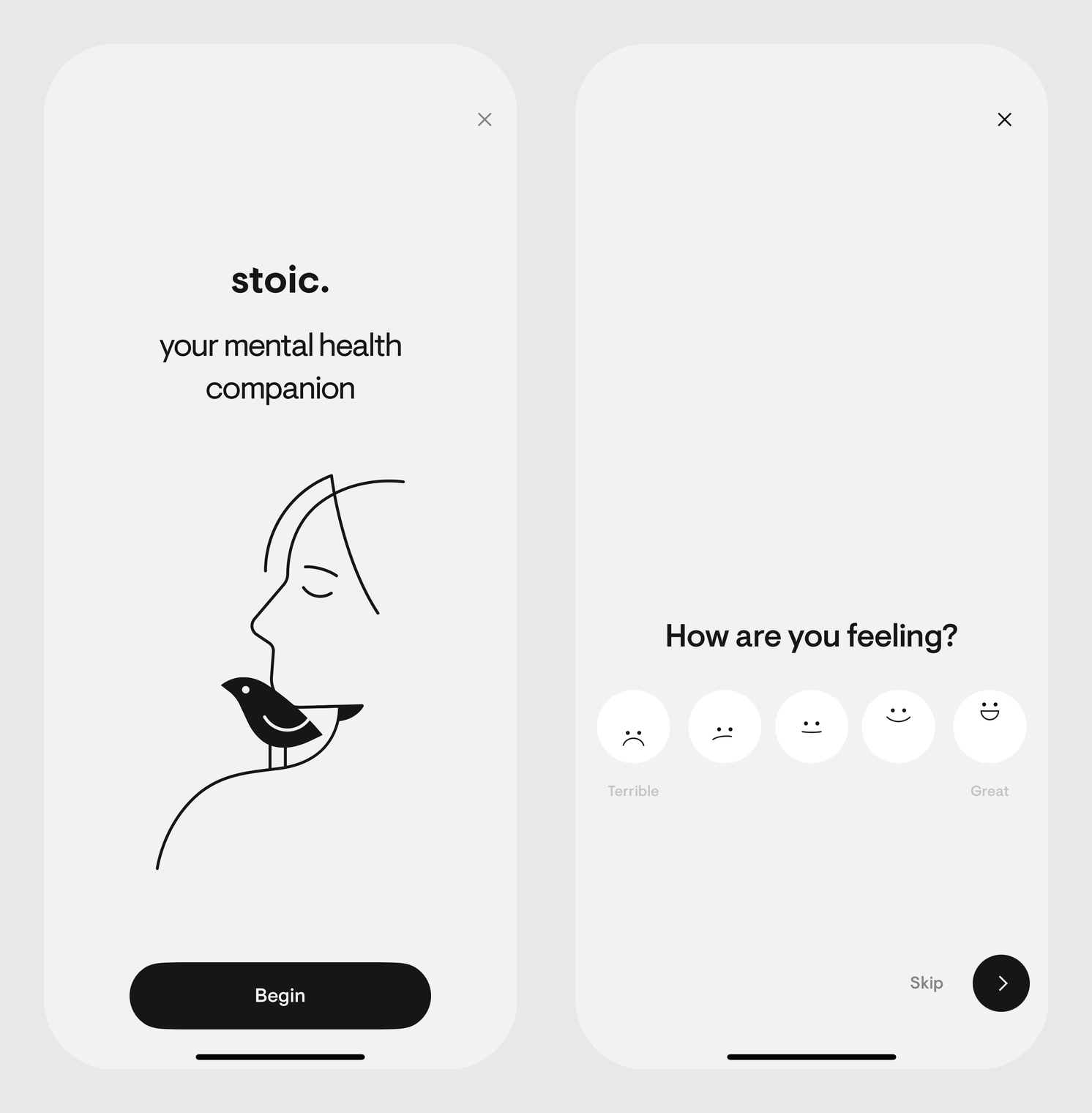
Snapshot: Stoic wraps journaling in a daily routine of morning preparation and evening reflection, flavored with Stoic philosophy. The free tier covers daily prompts and basic journaling; premium is around $49.99/year depending on regional pricing.
Why it works well. The app gives your day bookends. Morning and evening reflections, breathing exercises, meditations, and 500+ quotes create a ritual rather than a blank page. Its AI features add personalized prompts in the voice of Seneca or Marcus Aurelius and reflective analysis that surfaces patterns in your entries.
Standout features. Guided journals for sleep, stress, and productivity, habit and mood tracking, iCloud sync across iPhone, iPad, Mac, and Apple Watch, and passcode or Face ID protection.
Best for: Routine-builders and anyone drawn to Stoic practice. If you want your journal to tell you what to do at 7 in the morning and 10 at night, this is the one.
Potential drawbacks: The AI analysis is an add-on rather than the core experience, and it’s shallower than the dedicated AI journals here. The experience is strongest inside the Apple ecosystem. The philosophical framing, quotes and all, is either a feature or a gimmick depending on your taste.
6. Day One: best for traditional journaling with light AI
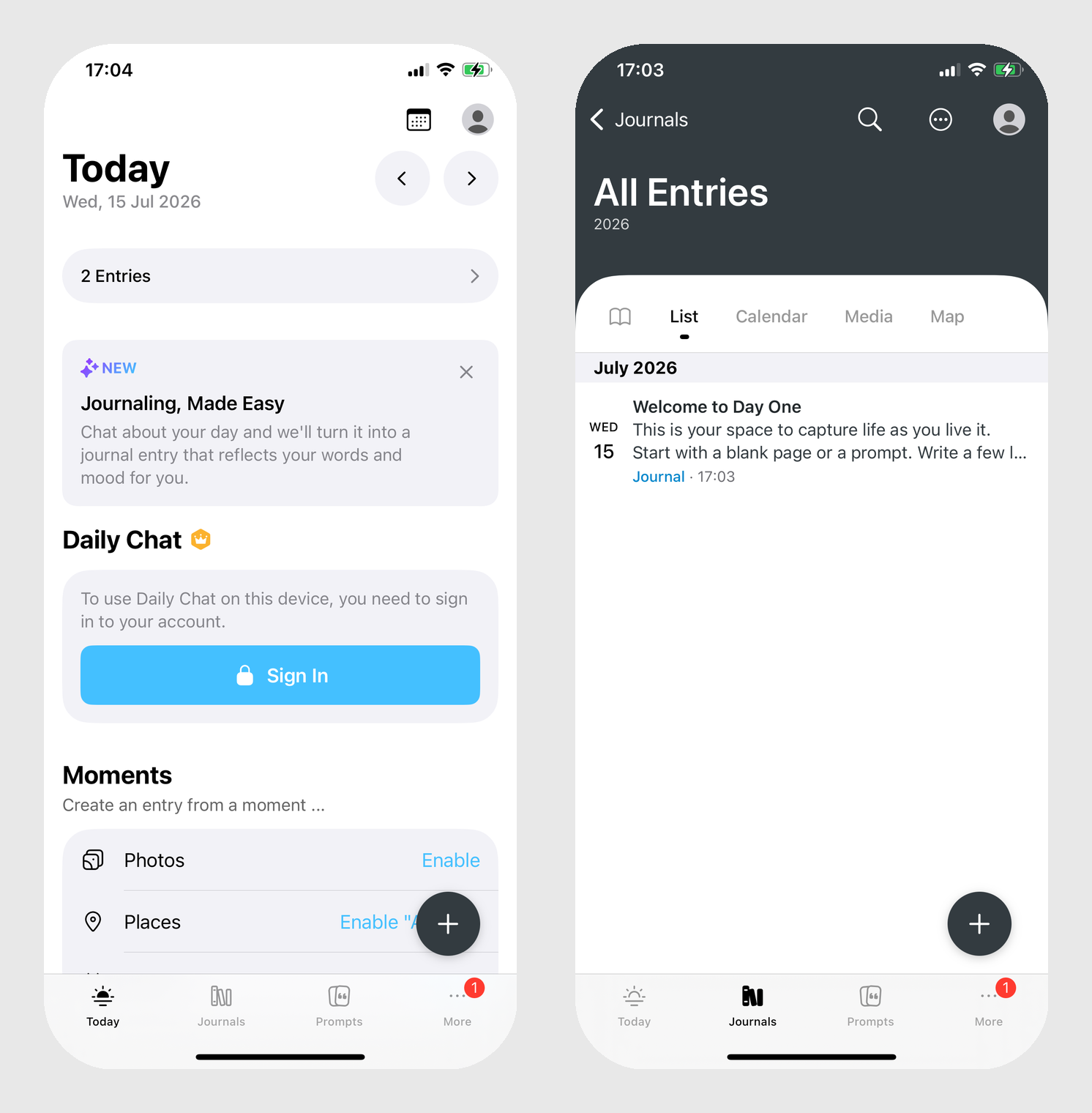
Snapshot: Day One is the veteran of digital journaling, built for capturing life: photos, locations, audio, and years of entries. AI arrived in April 2026 with the new Gold plan. Basic is free, Silver is $49.99/year, and Gold with AI features is $74.99/year.
Why it works well. Day One is great for archiving your life. Up to 30 media attachments per entry, automatic metadata like location and weather, “On This Day” resurfacing, and end-to-end encryption for your entries. The Gold plan adds Daily Chat for conversational journaling, entry summaries, highlights, and AI image generation.
Standout features. Best-in-class media support, multiple journals, printed books from your entries, and integrations with Strava, Zapier, and IFTTT.
Best for: Long-term diarists who mainly want a beautiful, private archive and are curious about AI as a bonus, not the point.
Potential drawbacks: The AI features are new and feel supplementary: there’s no emotional analysis across time, no frameworks, and no adjustable AI perspectives. Getting AI at all requires the most expensive tier, which costs more than some dedicated AI journals. Daily Chat launched on iPhone and iPad first.
7. ChatGPT: the DIY option
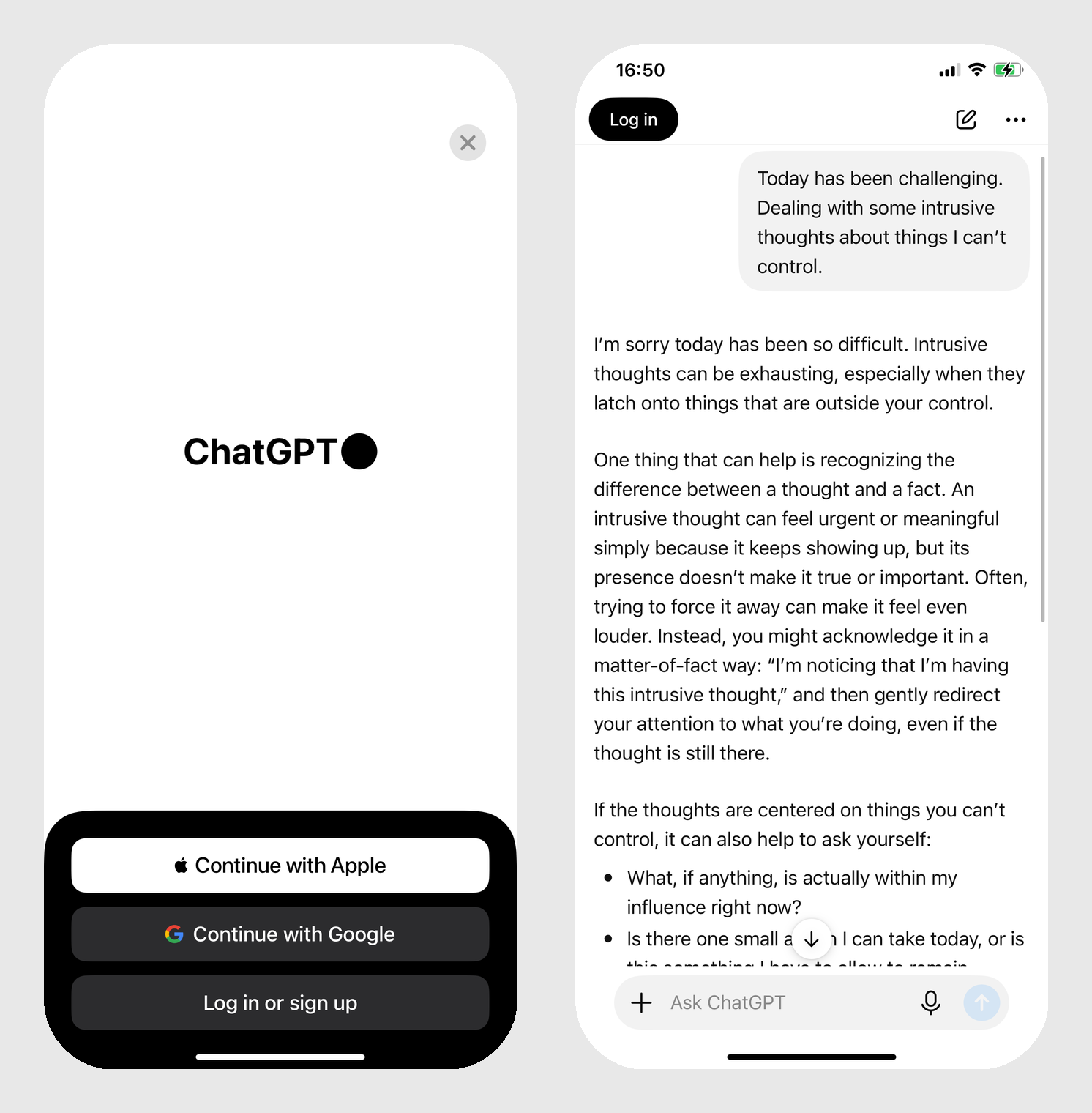
Snapshot: Plenty of people journal by typing into ChatGPT. The free tier costs nothing, Go is $8/month, and Plus is $20/month. It works, up to a point, and the point arrives sooner than you would expect.
Why it works well. ChatGPT is a capable conversationalist, it’s already on your phone, and with memory enabled it can recall things you told it before. If you just want to think out loud with an AI once in a while, it costs nothing to try.
Standout features. State-of-the-art models, voice mode, and total flexibility: you can prompt it to act like any kind of journaling coach you want.
Best for: Occasional reflection, or testing whether AI feedback on your thoughts is useful to you at all before buying a dedicated app.
Potential drawbacks: ChatGPT isn’t a journal. There’s no timeline of entries, no mood or emotion tracking, no streaks, and no structured review of your history. Its memory draws from everything you’ve ever asked it, recipes and work emails included, so the context is noisy rather than focused on your reflections. General LLMs also tend toward agreeable, validating answers, which is a real problem when what you need is honest reflection. We wrote a full breakdown of why general LLMs aren’t built for journaling.
Free plans compared
The most common question about this category: what do you actually get for free? Here’s where each paywall starts. Checked July 2026.
| App | Free tier includes | Where the paywall starts |
|---|---|---|
| Mindsera | Minimal journal, habit tracker, 52+ framework templates, tags, highlights, export | Voice and Call Mode, entry analysis, Minds, Ask Your Journal: Genius, $14.99/mo or $10.75/mo billed annually |
| Rosebud | Journaling with basic AI reflection, auto-tagging, weekly reports, 2 personalized prompts/day | Long-term memory, voice, Ask Rosebud: Bloom, $12.99/mo or $107.99/yr |
| Reflection | Core journaling, daily prompts, monthly and annual reviews, limited AI coach | Unlimited AI coaching, 100+ programs: $8/mo or $5.75/mo billed annually |
| Reflectly | Basic mood logging and prompts | Full statistics and prompt library: $9.99/mo or $59.99/yr |
| Stoic | Daily prompts, affirmations, basic journaling | Guided journals, meditations, AI analysis: ~$49.99/yr |
| Day One | Single journal, one photo per entry, one device | Sync and media: Silver $49.99/yr. AI: Gold $74.99/yr |
| ChatGPT | General chat with limited memory and usage caps | More usage and memory: Go $8/mo, Plus $20/mo |
If you want a free AI journal that writes back, Reflection is the closest thing: its free plan is the most complete, including limited AI coaching. Mindsera and Rosebud both offer free trials of their paid plans, which is the honest way to test AI features that free tiers only hint at.
Which one is best for you?
There’s no single best AI journaling app for everyone. Different needs, different winners:
- You want a therapist-adjacent guided chat. Rosebud’s CBT and ACT workbooks are built for exactly that. If you want the conversation with real analysis behind it, Mindsera’s Call Mode does both.
- You want zero cost. Start with Reflection’s free plan and upgrade only if the AI coach earns it.
- You want a 30-second daily habit. Reflectly or Stoic, depending on whether you prefer mood charts or morning routines.
- You want a lifelong archive. Day One, with AI as a side dish.
- You journal for performance, not just feelings. Founders, operators, and athletes tend to want decision frameworks and pattern detection rather than a sympathetic ear. Mindsera’s mental model library and Ask Your Journal feature are built for exactly that. Rosebud and Reflection lean more toward emotional wellness.
- You want your journaling to change how you think. Pick Mindsera. It’s the only app here that combines entry analysis, long-term emotion patterns, personality insights, and multiple AI perspectives that challenge your thinking instead of agreeing with it. Curious what that feels like in practice? Here’s what a guided AI journal feels like.
Conclusion
An AI journal is only worth switching to if it tells you something you didn’t already know. Storage is already solved, and pleasant chat is cheap. The best AI journal app for you is the one whose feedback you still trust three months in. The apps worth paying for are the ones that read what you wrote and hand you back a pattern, a blind spot, or a question you wouldn’t have asked yourself. That reflection is where the benefits of AI journaling actually come from, and it is the standard we would hold any app on this list to, including Mindsera.
Frequently asked questions
What is the best free AI journaling app?
Reflection.app has the most generous free plan: core journaling, daily prompts, guided reviews, and limited AI coaching at no cost. Mindsera and Rosebud have free tiers too, but their best AI features sit behind the paywall, so use their free trials to judge the full experience.
Is there an AI journal that writes back?
Yes. Mindsera analyzes every entry and leaves margin comments from AI personas called Minds, and its Call Mode even talks back in a live voice conversation. Rosebud replies conversationally, like a supportive chat partner. Both remember past entries, so the feedback gets more personal over time.
Are AI journaling apps private?
The good ones encrypt your data and exclude it from AI training. Mindsera encrypts writing at rest with AES-256 and never uses your entries to train models. Rosebud encrypts data and anonymizes what it sends to AI providers. Always check the privacy policy for a no-training commitment before writing anything sensitive.
What is the best AI journaling app for iPhone?
Mindsera holds a 4.9-star rating on the iOS App Store, has been featured by Apple in 49 countries, and ships an Apple Watch app for voice recording on the go. Rosebud and Reflection also have strong, well-reviewed iPhone apps. If you live inside the Apple ecosystem and want routines, Stoic syncs across iPhone, iPad, Mac, and Apple Watch.
Can I use ChatGPT as a journal?
You can, but it’s a workaround. ChatGPT has no entry timeline, no emotion tracking, and its memory mixes your reflections with everything else you ask it. Dedicated AI journals analyze your entries in a structured way and keep that context clean. ChatGPT is fine for occasional thinking out loud, not for a practice.